What Flooring Should You Update Before Selling a Mississauga Home?
If you’re getting a Mississauga home ready to sell, don’t assume you need new flooring throughout the house.
A better approach is to identify what is visibly worn, damaged, or inconsistent with the rest of the home. A scratched hardwood floor may need refinishing. A bedroom carpet with a few years of wear may be perfectly fine. A soft spot in the basement, on the other hand, should be investigated before you worry about which flooring to install.
The goal is to make the home look clean, cared for, and consistent without spending thousands of dollars on work that may not be necessary.
What flooring should you fix before selling?
Start with the floors that have obvious defects.
Walk through the house in daylight and look for:
- badly scratched or worn hardwood;
- stained or heavily worn carpet;
- loose or rippled carpet;
- cracked or loose tiles;
- damaged boards;
- soft spots;
- significantly uneven areas;
- broken transitions;
- damaged stair nosings;
- obvious gaps or unfinished trim.
Not every dated floor needs to be replaced.
A 15-year-old floor that is clean and in good condition can look better than a brand-new floor that was installed poorly. If the existing flooring works with the rest of the house, leaving it alone may be the better decision.
The first question should be:
Is there a visible problem that needs attention?
If the answer is no, there may be no reason to renovate.
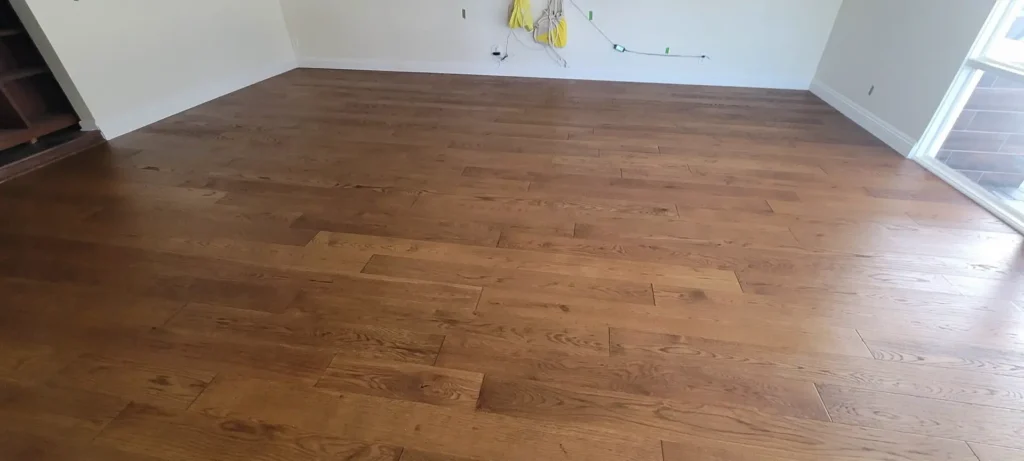
Before replacing flooring, find out why it looks bad
Some flooring problems are cosmetic. Others are symptoms of something underneath.
For example, scratched hardwood may only need refinishing. Rippling carpet may simply need stretching. A soft floor near a bathroom or exterior door could indicate moisture damage.
Replacing the finished floor without addressing the underlying problem is an expensive way to hide an issue temporarily.
If you find a soft area, significant unevenness, water damage, or recurring movement, investigate that first.
A sensible order is:
Inspect → diagnose → repair → install.
That sequence can prevent an otherwise unnecessary flooring replacement.
Have existing hardwood assessed before replacing it
If your home already has hardwood, don’t price replacement until you’ve found out whether the existing floor can be restored.
A tired finish and surface scratches do not necessarily mean the hardwood needs to be removed.
Refinishing can involve sanding the existing finish, repairing damaged boards, staining if required, and applying a new protective finish. The result can be a significant improvement without removing the entire floor.
The 2022 Remodeling Impact Report from the National Association of REALTORS® and the National Association of the Remodeling Industry reported estimated cost recovery of 147% for hardwood floor refinishing and 118% for new wood flooring. Those figures are based on a U.S. survey and should not be treated as a prediction for a Mississauga property.
What matters for your home is the condition of the actual floor and the scope and cost of the work.
When hardwood refinishing may make sense
Ask a flooring professional to assess the floor if you have:
- surface scratches;
- a worn or dull finish;
- minor colour variation;
- isolated damaged boards;
- otherwise solid flooring that has simply aged.
The installer should also determine how much usable wood remains and whether the floor has already been sanded several times.
Engineered hardwood needs additional consideration. Its ability to be refinished depends on the thickness of the actual wood wear layer, the condition of the floor, and the manufacturer’s specifications.
When replacement may be necessary
Replacement becomes more reasonable when the existing floor has extensive damage, insufficient material for another sanding, or problems that make restoration impractical.
Water damage should be dealt with before refinishing or replacing the visible surface.
If only a few boards are damaged, ask whether they can be repaired or replaced rather than assuming the entire floor has to go.
Don’t replace good carpet just because you’re selling
Carpet does not automatically need to be replaced before a sale.
If it is clean, neutral, flat, and reasonably well maintained, leaving it in place may make more sense than replacing it.
Replacement becomes more worthwhile when the carpet has:
- permanent stains;
- strong or persistent odours;
- significant wear;
- burns or other obvious damage;
- extensive matting;
- loose seams or damage that cannot be repaired.
If the carpet is simply loose or rippled, professional stretching may solve the problem.
If you’re dealing with an older Mississauga home, check whether there is hardwood underneath before ordering several thousand dollars’ worth of new carpet. A small inspection in a closet or another discreet location can tell you what you’re dealing with.
Hidden hardwood is not automatically worth restoring. It may have stains, missing boards, adhesive, or a history of previous sanding. But knowing what is underneath can help you compare restoration with replacement before committing to new carpet.
Should you replace flooring throughout the house?
Usually, no.
You don’t need to give every room the same flooring simply because you’re selling.
What matters is whether the different materials look intentional and whether any of them are noticeably worn.
For example, if the main floor has clean hardwood but an adjoining room has badly damaged laminate, replacing that problem area may make more sense than renovating the entire first floor.
On the other hand, if several connected rooms have mismatched, worn flooring, selective replacement may leave the house looking patchy. In that situation, price the larger project and compare it with the cost of repairing or refinishing what you already have.
Pay attention to:
- transitions between rooms;
- differences in floor height;
- stairs;
- door clearances;
- baseboards;
- trim;
- how the rooms connect.
The goal isn’t uniformity for its own sake. It is a finished-looking result.
Vinyl and laminate can work, but choose the actual product carefully
Vinyl and laminate are often considered when replacing flooring before a sale, particularly when a homeowner wants a wood-look floor without installing new hardwood.
Both can be reasonable choices. Neither category is automatically right for every room.
Look at the specific product and the conditions in the room where it will be installed.
For a kitchen or entry, consider traffic, spills, cleaning, and moisture exposure.
For a basement, look at the condition of the concrete or subfloor and determine whether there is a moisture problem before choosing the flooring.
For a condo, there may also be acoustic requirements or restrictions on the type of flooring and underlay that can be used.
Don’t choose a product simply because the packaging says “waterproof.” Waterproof flooring does not make a wet basement dry, and it does not repair a leaking plumbing connection.
Basement flooring needs special attention
Basements deserve more investigation than a typical bedroom or living area.
Before installing new flooring, check for:
- water intrusion;
- excessive moisture;
- damaged subflooring;
- uneven concrete;
- previous water damage;
- conditions that could affect the manufacturer’s installation requirements.
If the basement has a moisture problem, address that before choosing flooring.
A good flooring product installed over an unsuitable substrate is still a bad flooring job.
The same applies to laminate. Some modern laminate products have better moisture resistance than older products, but that does not mean every laminate floor belongs in every basement.
Read the requirements for the specific product you’re buying.
What about tile?
Tile can be suitable for kitchens, bathrooms, entries, and laundry areas, but cracked tile deserves a closer look.
One cracked tile could be accidental damage. Several cracked or loose tiles may indicate movement in the substrate or another installation problem.
If the surrounding installation is sound, replacing a small number of tiles may be enough.
If cracking keeps appearing, don’t simply cover the problem with new tile. Find out why it is happening.
Heated floors are nice, but don’t install them just for resale
Heated flooring can be a worthwhile comfort feature, particularly in a bathroom that is already being renovated.
I wouldn’t tear up an otherwise finished bathroom solely to install heated flooring because you’re preparing to sell.
There is no reliable basis for assuming that adding heated flooring will produce a particular increase in your sale price.
If the floor is already being removed, however, the calculation changes. At that point, adding a compatible heating system may be more practical than doing the work later.
Before installing one, confirm that the heating system and flooring are compatible and check the electrical and installation requirements.
Fix the floor underneath before worrying about the finish
One of the most important parts of a flooring renovation is the part that ends up underneath the finished floor.
Before new flooring goes down, check for:
- soft spots;
- significant dips;
- damaged plywood or other subfloor material;
- moisture damage;
- loose sections;
- excessive movement;
- substrate conditions outside the flooring manufacturer’s requirements.
This is particularly important with floating floors. Many products have specific requirements for how flat the substrate needs to be.
A contractor who gives you a very low installation price may simply be assuming that the existing floor is already ready for installation. If that assumption turns out to be wrong, the final cost can change quickly.
Ask about substrate preparation before comparing quotes.
Condo owners should check the rules first
If you’re selling a Mississauga condo, check the condominium corporation’s requirements before ordering flooring.
The Condominium Authority of Ontario recommends that owners review their governing documents and contact the corporation before undertaking renovations. Depending on the building, you may have requirements concerning approval, contractors, acoustic performance, work hours, insurance, elevator bookings, or other aspects of the renovation.
Don’t assume that a flooring product is acceptable simply because it is commonly used in condos.
Ask the property manager or board:
- Is approval required?
- Are there acoustic requirements?
- Is a particular underlay required?
- Are certain installation methods prohibited?
- Do contractors need to be approved?
- What are the permitted renovation hours?
- Does the elevator need to be booked?
- Are insurance documents required?
- Is an inspection required?
Municipal requirements and condominium requirements are separate. Satisfying one does not automatically satisfy the other.
What about Mississauga permits?
A straightforward flooring replacement does not necessarily mean you need a building permit, but you should look at the complete scope of the renovation rather than making assumptions based on the word “flooring.”
The City of Mississauga’s current building-permit guidance includes interior alterations among work that can require a permit, while also identifying work that does not.
If flooring is part of a larger renovation involving structural changes, plumbing, HVAC, or other regulated work, the requirements can be different.
If you’re unsure, check the City’s current requirements before starting the work.
Where should you spend the money?
If you’re preparing a home for sale on a limited budget, prioritize flooring work in this order.
1. Fix underlying problems
Deal with moisture, damaged subflooring, soft areas, and significant unevenness first.
2. Fix obvious defects
Repair badly damaged hardwood, cracked flooring, broken transitions, damaged stairs, and carpet that is clearly beyond cleaning or stretching.
3. Improve the main living areas
Prioritize the main living areas and other highly visible spaces.
4. Deal with high-traffic areas
Entries, hallways, kitchens, and stairs can show wear quickly.
5. Consider cosmetic upgrades
Once the necessary work is done, decide whether refinishing, selective replacement, or another upgrade is worthwhile.
Heated floors and premium finishes should generally come after necessary repairs unless they are already part of a renovation.
Get flooring quotes based on the complete job
The price per square foot isn’t enough to compare flooring contractors.
A quote should make it clear whether you’re paying for:
- flooring material;
- underlay;
- demolition;
- disposal;
- subfloor preparation;
- levelling;
- installation;
- transitions;
- baseboards or shoe moulding;
- stairs;
- furniture moving;
- staining;
- finishing;
- taxes.
For hardwood refinishing, ask specifically about board repairs, sanding, stain, number of finish coats, furniture moving, and curing time.
For replacement flooring, ask whether the quote assumes the existing substrate is in suitable condition.
Most importantly, ask what happens if the installer discovers damage after removing the existing flooring.
You don’t need the contractor to predict every possible problem. You do need to know how additional work will be identified, priced, and approved.
Plan the work before listing
Don’t finish the flooring the day before your photographer arrives.
Hardwood refinishing involves sanding, finishing, and curing. Replacement flooring can involve demolition, preparation, installation, and trim work.
Ask the installer when the floor will actually be ready for:
- furniture;
- rugs;
- normal foot traffic;
- cleaning;
- photography.
“Installation complete” and “ready for listing photos” are not necessarily the same thing.
Give yourself some extra time in case the old flooring exposes a problem that wasn’t visible beforehand.
A simple pre-sale flooring checklist
Before spending money, ask:
- Which floors actually look damaged?
- Which ones only need cleaning?
- Can the carpet be stretched instead of replaced?
- Is there hardwood underneath older carpet?
- Can the existing hardwood be refinished?
- Are there moisture or subfloor problems?
- Are any areas soft or significantly uneven?
- Will the new flooring create height problems at doors or transitions?
- Do the stairs need work?
- Does the condo corporation require approval?
- Are there acoustic requirements?
- Does the larger renovation require a municipal permit?
- Does the quote include demolition and disposal?
- Does it include substrate preparation?
- How will unexpected repairs be handled?
- Will the completed floor be ready before photography?
If the answers show that the flooring is already in good shape, leave it alone.
If there is a repairable problem, repair it.
If the flooring is genuinely beyond practical repair, then look at replacement.

Frequently Asked Questions
What is the best flooring to increase home value before selling?
There isn’t one flooring material that increases the value of every Mississauga home.
If you already have hardwood in reasonable condition, find out whether refinishing makes sense before replacing it. For other rooms, consider the condition, layout, traffic, moisture exposure, and how the existing flooring fits with the rest of the house.
Should I replace carpet before selling?
Only if the carpet is creating a noticeable problem.
Bad stains, strong odours, heavy wear, or obvious damage can justify replacement. Clean carpet that is simply a few years old usually doesn’t need to be removed just because the house is going on the market.
Should I refinish hardwood before listing?
If the hardwood is structurally sound but the finish is worn, it is worth getting a refinishing quote.
If there is major board damage, moisture damage, or insufficient material remaining for another sanding, repair or replacement may make more sense.
Should I replace flooring throughout the house?
Not automatically.
Focus on flooring that is visibly damaged, worn, or inconsistent with the surrounding rooms. Good flooring in bedrooms or secondary areas can often stay.
Does vinyl flooring hurt resale value?
There is no general rule that vinyl flooring reduces the value of a home.
The quality of the product, installation, appearance, room, and overall condition of the property matter more than simply whether the floor is vinyl.
Is vinyl flooring waterproof?
Some products are sold as waterproof, but that doesn’t mean the room itself is waterproof.
The product, seams, installation, perimeter details, substrate, and source of moisture all matter.
A waterproof floor won’t fix a leaking pipe or a wet basement.
Is laminate suitable for a basement?
It depends on the product and the basement.
Some laminate products have better moisture resistance than others. Check the manufacturer’s requirements and investigate the basement’s moisture conditions before installation.
Can hardwood be installed over concrete?
Some hardwood flooring systems are designed for concrete, but not every product is.
Check the specific flooring manufacturer’s installation instructions and the condition and moisture level of the concrete.
Can hardwood be installed over heated floors?
Some products are compatible with radiant heating and others are not.
Check the flooring and heating-system requirements before installation.
Do condo owners need approval to replace flooring?
They may.
Check the condominium corporation’s declaration, by-laws, rules, and renovation procedures before ordering materials.
Does replacing flooring require a Mississauga building permit?
It depends on the project.
A simple flooring replacement may be treated differently from flooring work that forms part of a larger interior alteration. Check the City of Mississauga’s current permit requirements for the complete renovation.
Should I install heated flooring before selling?
Only if it makes sense as part of the renovation you’re already doing.
It can be a useful comfort feature, but there is no reliable basis for promising a specific resale return.
What should I check under carpet?
If the home is old enough that hardwood may be underneath, inspect a discreet area before ordering replacement carpet.
Look for the condition of the hardwood, stains, missing boards, repairs, adhesive, and signs of previous sanding.
Should I renovate flooring or leave it alone?
If it is clean, functional, presentable, and appropriate for the home, leave it alone.
Fix flooring when it has a noticeable defect, creates a poor presentation, or has an underlying problem that needs attention.
Selling a house is not, by itself, a reason to replace usable flooring.
What should a flooring quote include?
Ask for a written scope covering material, installation, demolition, disposal, substrate preparation, levelling, trim, transitions, stairs, and finishing where applicable.
Also ask how unexpected damage will be handled.
How long should flooring be finished before listing photos?
It depends on the flooring and installation system.
Hardwood refinishing requires curing time. Replacement flooring may require preparation, installation, and trim work.
Ask the installer when the floor will be ready for furniture, normal use, cleaning, and photography rather than relying only on the installation completion date.
The bottom line
You don’t need every floor in a Mississauga home to be new before putting it on the market.
If the hardwood is good but tired, investigate refinishing. If the carpet is clean and presentable, leave it. If a floor is badly damaged, repair or replace it. If something is soft, uneven, or showing signs of moisture, find out why before installing anything new.
Spend the money where the existing flooring has a genuine visible or functional problem.
The best pre-sale flooring project is not necessarily the biggest one. It is the one that addresses the condition of the home without turning sale preparation into an unnecessary full renovation.