Carpet vs. Vinyl Plank Basement Flooring in Mississauga
If you’re finishing a basement in Mississauga, carpet and vinyl plank are two of the most common flooring choices. Both can work well, but they solve different problems.
On price, they are closer than most people expect. Installed, carpet in the GTA usually runs about $4 to $10 per square foot and vinyl plank about $4 to $9 per square foot, before removal of the old floor or concrete work. For an 800 sq. ft. basement that is roughly $3,200 to $8,000 for carpet and $3,200 to $7,200 for vinyl plank.
Carpet is usually the better choice if comfort and a warmer feel are your priorities. Vinyl plank makes more sense when you want something easier to clean and less sensitive to everyday spills.
The bigger issue in a basement is often not the flooring itself. It’s the concrete underneath it. Before choosing a material, check whether the slab is dry, reasonably flat, and free of active water problems.
Carpet or vinyl plank: which makes more sense?
| Carpet | Vinyl Plank | |
|---|---|---|
| Typical installed price | About $4-$10/sq. ft. | About $4-$9/sq. ft. |
| Feel underfoot | Soft and warm | Harder, but can be comfortable with the right setup |
| Cleaning | More involved | Easier |
| Spills | Need to be cleaned quickly | Easier to wipe up |
| Basement comfort | Excellent | Good |
| Moisture tolerance | Lower | Generally better |
| Best for | Bedrooms, playrooms, family rooms | Rec rooms, offices, gyms, general living space |
Your price depends on the product you pick, the condition of the basement floor, the installation method, removal, and other preparation work. A written quote after the basement has been seen is the real number.
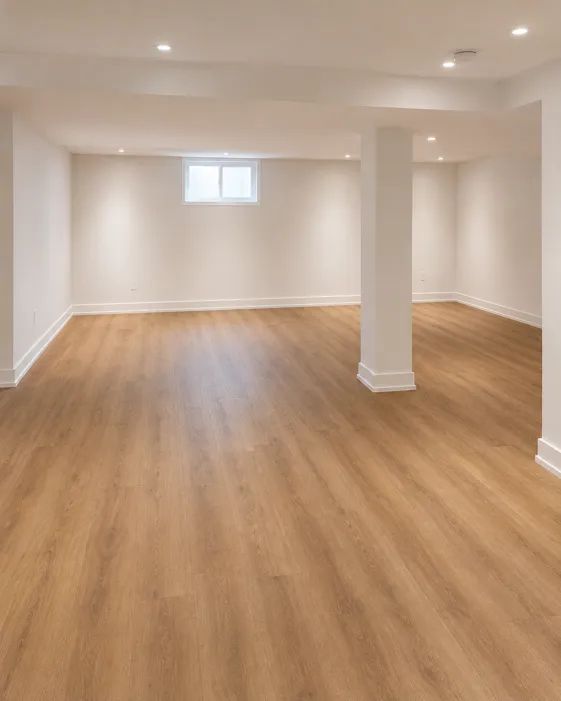
What does basement flooring cost?
We list carpet at about $4 to $10 per square foot installed and vinyl plank at about $4 to $9 per square foot installed. Where you land depends mostly on the grade of the product and how much prep the concrete needs. Removing the old floor typically adds about $1 to $3 per square foot.
Using an 800 sq. ft. basement:
Carpet
- Installed: about $3,200 to $8,000
- With removal of the old floor: about $4,000 to $10,400
Vinyl plank
- Installed: about $3,200 to $7,200
- With removal of the old floor: about $4,000 to $9,600
Your final price can fall outside these numbers if the concrete needs repair or the installation needs extra moisture protection. Concrete levelling, where it is needed, typically adds about $2 to $4 per square foot on the areas that need it.
What can change the price?
The flooring itself is only one part of the job.
A quote may include:
- Flooring material
- Installation labour
- Carpet pad or required underlayment
- Removal of existing flooring
- Disposal
- Concrete repairs or leveling
- Moisture-related preparation
- Baseboards and trim
- Transitions between flooring types
- Stair work, if applicable
This is why two contractors can give you very different prices for what appears to be the same basement.
When carpet is the better choice
Carpet is hard to beat when you want the basement to feel like another comfortable living area.
It’s particularly useful for:
- Bedrooms
- Playrooms
- Family rooms
- TV rooms
- Areas where people spend a lot of time sitting or playing on the floor
It also hides minor imperfections in the concrete and feels warmer than a hard flooring surface.
The tradeoff is maintenance. If someone spills a drink, tracks in mud, or brings moisture into the room, carpet requires more attention than vinyl.
A good carpet installation also depends on using a pad and installation system that are appropriate for the carpet and the basement conditions.
When vinyl plank is the better choice
Vinyl plank is often the practical choice for basements that get a lot of traffic or are used for activities where spills are likely.
It’s a good fit for:
- Rec rooms
- Home offices
- Gyms
- Hobby areas
- General-purpose basement spaces
One thing to know before you buy:
Waterproof vinyl does not make a basement waterproof.
A waterproof plank can handle water reaching the flooring surface, depending on the product and installation. It does not solve water coming through the foundation, a leaking wall, hydrostatic pressure, or a wet concrete slab.
The manufacturer’s installation requirements still matter, particularly when the flooring is going directly over concrete.
Don’t skip the concrete inspection
This is probably the most important part of a basement flooring installation.
Look for obvious signs of water first. Staining, damp spots, efflorescence, musty smells, or previous flooding can all be reasons to investigate further before installing new flooring.
Then look at the slab itself.
It should be reasonably flat for the flooring system being installed. Larger cracks, uneven areas, damaged concrete, or other problems may need to be dealt with before installation.
Moisture is a separate issue from visible water. A concrete slab can look completely dry while still having moisture conditions that matter for a particular flooring product or adhesive.
If moisture testing is recommended, the acceptable result depends on the flooring system and the manufacturer’s requirements. There isn’t one moisture number that works for every product.
Fixing a moisture problem after new flooring has been installed is considerably more frustrating than finding it before the installation starts.
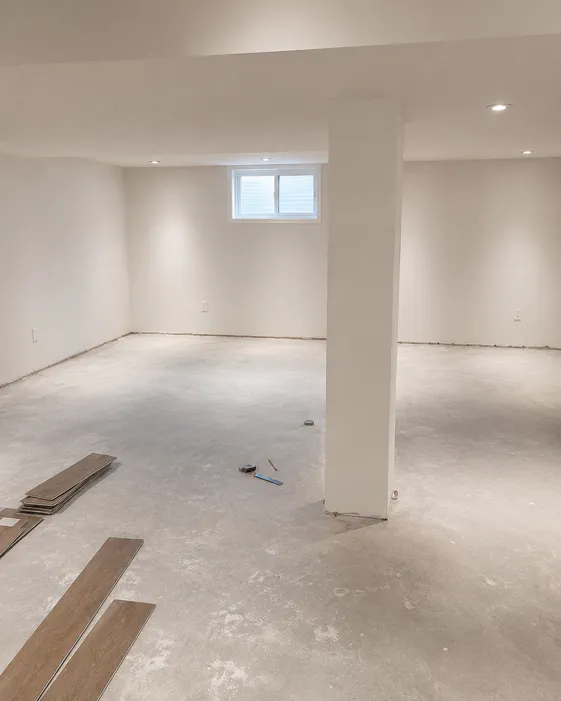
Which flooring works best in different basement rooms?
For a basement bedroom or playroom, I’d generally lean toward carpet if comfort is the main concern.
For a rec room, office, or gym, vinyl plank is often easier to live with because cleaning is simple and the surface handles everyday messes better.
If the basement is occasionally damp or has a history of water problems, don’t treat the flooring choice as the solution. Deal with the moisture issue first.
What about the existing floor?
If you’re replacing old carpet, vinyl, laminate, or another floor, ask the installer whether removal and disposal are included.
This can make a noticeable difference in the final bill.
Older flooring can also require additional caution. Some older building materials may contain asbestos. You cannot reliably determine whether a material contains asbestos just by looking at it. If an older material is suspicious and will be disturbed during renovation, have it assessed appropriately before removal.
How to compare basement flooring quotes
Don’t compare contractors based only on the number at the bottom of the quote.
Ask each installer to break out the major parts of the job.
At minimum, you should be able to see:
- Flooring product and brand
- Product grade or collection
- Square footage
- Installation labour
- Carpet pad or underlayment
- Removal and disposal
- Concrete preparation
- Moisture-related work, if required
- Baseboards and trim
- Transitions
- Stairs, if applicable
- Taxes
This makes it much easier to see why one quote is higher than another.
A contractor quoting $8,000 for vinyl may not actually be more expensive than someone quoting $6,500 if the first price includes concrete preparation, removal, trim, and disposal while the second does not.
Do you need a vapor barrier?
Not automatically.
The right installation depends on the flooring product, the condition of the concrete, and the manufacturer’s installation instructions.
Some systems have specific requirements for moisture protection or underlayment. Others are installed differently.
So instead of assuming that every basement needs the same vapor barrier, ask the installer what the specific flooring manufacturer requires for installation over your concrete slab.
More importantly, a vapor barrier is not a substitute for fixing active water intrusion.
Can you install carpet directly over concrete?
Carpet can be installed over concrete when the slab and installation system are suitable.
The installer should consider moisture, cleanliness, flatness, and the appropriate carpet pad and installation method.
If the slab has an unresolved moisture problem, putting carpet and pad over it doesn’t fix the problem. It can simply make the problem harder to deal with later.
How much does it cost to remove old basement flooring?
Old flooring removal runs roughly $1 to $3 per square foot, so about $800 to $2,400 for an 800 sq. ft. basement. Where you land depends on what is already there.
Pulling up loose carpet and pad sits at the low end. Glued-down flooring, tile, or several layers of old material sit at the high end.
Ask whether removal and disposal are included in the flooring quote rather than assuming they’re part of the installation price.
If the existing material is old or potentially hazardous, get the appropriate assessment before anyone starts tearing it out.
Do you need a permit to install basement flooring in Mississauga?
A simple flooring replacement is different from finishing a basement or changing the space itself.
The City of Mississauga states that permits are required for certain basement finishing work, including work that creates rooms or living space, as well as other alterations involving areas such as plumbing, HVAC, structural components, and basement apartments.
If your flooring project is part of a larger basement renovation, check the City’s current permit requirements before starting.
Swapping the floor in an already-finished basement is a different job. The City’s permit page lists painting as work that does not need a permit but does not mention flooring, so call 311 if you want it confirmed for your project.
So, which one should you choose?
If this were my basement, I’d make the decision based on how the room will actually be used.
Choose carpet if you want:
- A softer floor
- A warmer feel
- Better comfort for bedrooms and family areas
- A more traditional finished-basement feel
Choose vinyl plank if you want:
- Easier cleanup
- A harder-wearing surface
- Better practicality for rec rooms and offices
- A floor that is less troublesome when everyday spills happen
But before either one goes down, make sure the basement itself is suitable for flooring.
The best flooring installation is not the one with the cheapest material. It’s the one where the product, concrete, moisture conditions, preparation, and installation method all work together.
And when you’re comparing prices, make sure you’re comparing the same scope of work, not just the same square-foot price.